
“I like my money where I can see it, hanging in my closet.”
You know this famous quote, right? Yes, true, it’s coming from Carrie Bradshaw, one of the characters in The Sex and the City series. And girl, did she mean it. From Manolos to vintage finds, Carrie made shopping look like a personality trait. There’s a moment before in my life when I truly related to it. But that kind of moment slowly disappeared. It’s not fully disappeared, though, I’m only an ordinary woman! But, I give my best shot to not let it consume my mind again. Let’s figure it out together!
Fast forward to now, how many of us, instead of brunching in the Upper East Side, we’re scrolling TikTok at 9 pm whispering “treat yourself” while adding 5 lip glosses, a sunset lamp, and an air fryer we don’t need to our cart. #TikTokMadeMeBuyIt has become the millennial and Gen Z version (maybe Gen X too!) of emotional coping, complete with same-day delivery.
But honestly, sometimes it is a treat, but sometimes, it’s a tiny scream for help dressed up in cute packaging.
Because emotional spending doesn’t always look like bags of luxury goods. Sometimes it’s buying something random after a stressful meeting. Sometimes it’s convincing ourselves, we need that skincare set because our friend looks prettier than us.. Or grabbing a fifth notebook because at least this one, yes, this one, will finally make us organized.
Sound familiar?
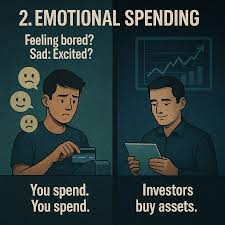
The psychology behind it makes sense. When we feel out of control emotionally, we try to gain control externally. And hitting “Add to Cart” feels like a win. A little high. A moment of “I deserve this”, especially when the world feels chaotic.
But that temporary high? Often followed by the crash. We know it very well: the unopened packages, the growing credit card bill, the slow realization that nothing we bought actually solved what we were feeling.
It’s like retail therapy is the emotional band-aid we keep reapplying, even when the wound needs stitches.
We don’t need to villainize emotional spending, we just need to understand it. The goal isn’t to never shop again. The goal is to pause long enough to ask: Am I buying this because I want it… or because I’m trying to fix a feeling?
Try this next time:
- Had a bad day? Before buying something, write down how we feel in your Notes app.
- Add it to our wishlist and wait 30 days.
- If we still want it, go ahead. (Spoiler alert: It’s a rare moment.)
- If not, congrats, wesaved both money and future regret. Hooray!
As financial therapist Bari Tessler says in The Art of Money, “Money is never just about money. It’s about emotions, history, identity, values, and so much more.”
And this ties perfectly with what Morgan Housel explores in The Psychology of Money: how we manage money is more often about behavior than knowledge. We spend emotionally, save inconsistently, and justify it all in ways that make us feel rational, even when we’re not. Housel writes, “Doing well with money has a little to do with how smart you are and a lot to do with how you behave.”
That’s why emotional spending isn’t just about shopping. It’s a self-awareness cue. It’s about recognizing when our purchases are replacing reflection. That maybe, just maybe, what we’re really craving isn’t in our cart, but in our calendar: time to rest, time to talk it out, or time to care for our emotional health in a deeper way.
So maybe next time we’re tempted to drop a hundred bucks because we’re on cloud number 9, or heartbroken, overwhelmed, or just bored, try something different. Call a friend. Dance it out to Bruno Mars’ “Uptown Funk”. Go outside. Scream into a pillow. Journal. Meditate. Watch Netflix again (but don’t do binge, duh!) Anything that doesn’t leave us with buyer’s remorse and a mystery parcel.
Because “treating yourself” is not about spending money, but about relaxing and feeling good.
Our future self will thank you. And so will our bank account. And if all else fails, ask yourself: Would I still buy this if I were in a good mood?
Now, if we’re ready to go deeper, here’s our challenge:
Spend the next week tracking our impulse buys. Not to judge ourselves, but to gently get curious. What mood were we in? What were we trying to soothe? What might we need instead next time?
Consider it the financial version of “he’s a 10 but…”, except the 10 is you, reclaiming your agency, one conscious swipe at a time.
And if Carrie Bradshaw had Morgan Housel on speed dial? She might’ve said: “I like my money where I can see it, growing in a high-yield stocks account.”
Love,
Kirana
