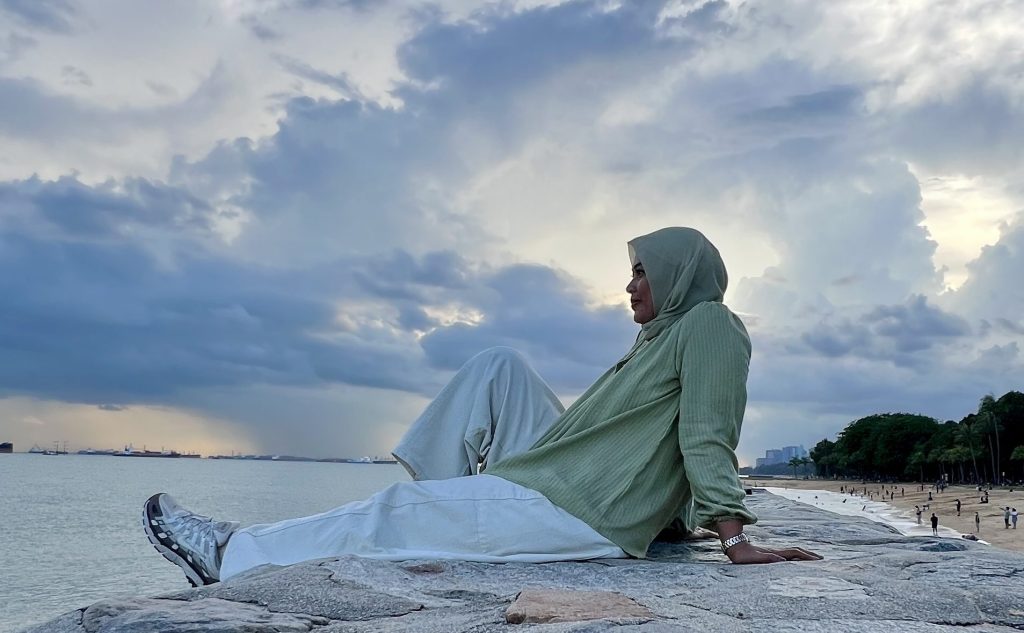
There is something about the ocean that always makes me want to stop.
Not because it is beautiful, though it definitely is. But because standing before it, I feel permitted to be still. Nothing needs to be explained, nothing needs to be defended. Just me, the horizon, and the sound of waves that come and go without asking anything in return.
Something about that stillness felt familiar. Like a quiet I had been looking for without knowing I was searching. And somewhere between the sound of the water and the absence of noise in my own head, it became clear.
That stepping back is not about disappearing. It is about finding enough distance to breathe, and returning more whole than before.
The ocean does this every single day. It retreats not because it surrenders to the shore. But because that is part of its rhythm. The tide coming in and going out are not contradictions; they are how the ocean remains the ocean.
In a world that measures closeness by how often we show up, stepping back is often misread. We fear looking cold, indifferent, or perhaps most haunting of all, like we have given up.
But there is a significant difference between walking away and creating distance. One closes the door. The other simply takes a step back to see more clearly.
Epictetus wrote that our control exists over only one thing: our own response. Not who others are, not how they think, not the choices they make. Only how we choose to position ourselves in relation to all of it.
And positioning ourselves, sometimes, means choosing distance.
Anne Elliot in Persuasion understood this better than anyone.
For years, she chose silence. Not out of resignation, not out of weakness. But because she knew there was something within her that could not be compromised, not even for a relationship she deeply loved. She stepped back, waited, and remained whole throughout.
What is compelling about Anne is not her happy ending. It is how she lived inside that distance, without bitterness, without drama, without losing herself. She did not close her heart. She simply refused to let someone else’s ambiguity define who she was.
Jane Austen seemed to know, two centuries ago, that the most powerful kind of stepping back is not the loudest. It is the quietest.
I once had a friendship with someone genuinely delightful, in so many ways. But there was something in their way of thinking that, every time I stayed silent about it, I felt like a quiet betrayal of something inside myself.
Not a grand, dramatic value. But persistent enough to not be ignored. There is a particular kind of discomfort that comes not from the other person, but from watching yourself look the other way. As if tolerating what does not sit right with you somehow makes you the fool. And the hardest part is knowing you are not a fool for caring , you are only human for hoping things might be different.
Marcus Aurelius wrote in Meditations that we cannot control what happens outside of us, only how we respond to it. And sometimes, the most honest response is not confrontation. Nor is it silence that pretends to agree.
It is a small, quiet step backward. Calm. Without drama.
This is not about closing ourselves off. It is about honoring ouselves.
Honoring ourselves does not always look noble. Sometimes it is quiet and almost invisible. It is choosing not to reach out when we fingers hesitate. It is allowing some notifications to simply exist without response. It is creating small gaps in the everyday presence of someone, not out of hostility, but out of self-preservation. Not to punish them. But to protect something in us that deserves to remain intact.
Because some relationships are worth keeping, and some distance is what keeps them honest. We do not have to choose between being fully present or leaving entirely. There is space in between, and sometimes that is exactly where we can breathe most freely.
Stepping back is not the end of the story. It can be a pause that gives us room to see whether something changes, whether there is something worth returning to.
And if there isn’t?
At least we did not lose ourselves in the process.
Love,
Kirana

Please share your thoughts!